


How uranium is mined in Ukraine and how it can be used for the energy sector

The Ukrainian energy system has been experiencing the largest-scale attacks from the enemy throughout the year. Therefore, the number one issue today is to strengthen the energy security and independence of our country.
Recently, the Cabinet of Ministers of Ukraine approved the Energy Strategy of Ukraine until 2050, which envisages the development of modern and safe nuclear generation and renewable energy sources. Electricity generation by nuclear power plants is possible, in part, due to the extraction and enrichment of uranium ore.
Uranium production is a very important issue, especially in the context of the energy industry development. On the one hand, uranium is a valuable resource for electricity generation, but on the other hand, its extraction and processing involve certain environmental risks and geopolitical challenges.
Uranium in Ukraine: availability of reserves.
As of 01.01.2021, uranium reserves and resources that can be obtained at a cost of up to $260/kgU amounted to 185,389 tU. This figure is 2.3% of the world’s reserves. At the same time, with production costs of up to $80/kgU, the price is 71,841 tU. The price includes the cost of uranium ore mining and enrichment. Two main types of deposits are of economic interest in Ukraine:
Metasomatic uranium. This type of deposit is located within the Ingulsky block of the Ukrainian crystalline shield. The uranium ores consist of albite veins with complex morphology, ranging in thickness from 2-3 m to 50 m. Ore minerals of uranium ores are represented by uraninite, coffinite, and brannerite. The uranium content in the ore is 0.1-0.2%. Deposits of this type are developed by underground mining. The deposits of this type include Novokonstantynivske, Michurinske, Centralne, Vatutinske, Severynivske, Zhovtorichenske, Pervomayske, etc.
Sandstone uranium. This type of deposits is located within the Dnipro-Bug metallogenic zone. This type of deposits includes industrial deposits, which are confined to coal-bearing deposits of the Buchach Formation and occur at depths of up to 70-90 meters. The ore deposits consist of separate ore bodies of stratiform and lenticular shape with a thickness of 3-10 m. Uranium in ore bodies is contained mainly in coal and clay substances: uranium-bearing leucoxene and iron hydroxides, sulfides, usually accompanied by uranium black (marcasite, pyrite, melnikovite, sphalerite, bravoite, etc.). The uranium content in the ore is 0.02-0.06%. In addition to uranium, these ores contain molybdenum, selenium and rare earth elements of the lanthanide group. Deposits of this type are developed by underground leaching. This type of deposits includes: Sadove, Bratske, Safonivske, Devladivske, Novohurivske, Surske, etc.
Other types of uranium deposits are currently classified as non-industrial in terms of mineralization, mining and other indicators.
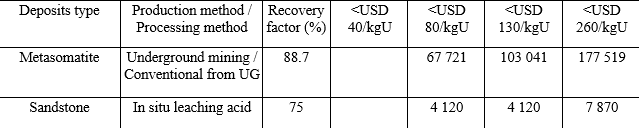
Table: Amount of uranium reserves in Ukraine depending on production cost, mining method and deposit type. Source: Red Book

Підпис до карти: Map of uranium ore deposits in Ukraine. Source: IAEA
Where uranium is mined in Ukraine?
Uranium production in Ukraine began in 1945 under the Soviet Union. Some of the deposits where uranium ore was mined were depleted by the 1970s (Zhovtorichenske, Pervomayske, Devladivske and Bratske). Kvitneve, Safonivske, Severynivske and Vatutinske (Smolinske mine, Smolino village) are not being developed or are in a state of conservation. Uranium ore is currently mined at three deposits: Michurinske and Centralne (separate subdivision of Ingulska mine, Kropyvnytskyi) and Novokonstantynivske deposits.
After the uranium ore is mined, it is sent to the plant in Zhovti Vody (Ukrainian city), where it is enriched to uranium oxide concentrate, which is called yellowcake. This is a yellow powder that is used to produce the uranium isotopes 233 and 235 used in nuclear power. Although Ukraine has significant reserves of uranium ore and is producing uranium oxide, it does not have the capacity to produce nuclear fuel on its own.
Use of uranium.
Uranium has been used for more than 2,000 years. Until the mid-twentieth century, uranium was used only as a coloring agent for glass and ceramics. Uranium compounds were used to give a yellow-green color to vases and decorative glassware. Ceramic glazes ranging from orange to bright red were used on a variety of objects such as household utensils and architectural decorations.
In 1945, uranium and plutonium were first used to make bombs. Uranium and plutonium for nuclear weapons is different from nuclear fuel used for power plants. Highly enriched uranium is used for nuclear weapons.
The most important use of uranium is nuclear power. Uranium provides us with nuclear fuel used to generate electricity at nuclear power plants. On June 27, 1954, the Obninsk Nuclear Power Plant in the Soviet Union became the world’s first nuclear power plant to generate electricity for the grid, producing about 5 megawatts of electricity.
There are also other uses for nuclear reactors. About 200 small nuclear reactors power about 150 ships, ranging from icebreakers to aircraft carriers, but mostly submarines. The heat generated by nuclear reactors can also be used for heating rather than electricity generation. In Sweden and China, for example, excess heat is used to heat buildings. Nuclear heat can also be used for various industrial processes, such as desalination or hydrogen production.
Depleted uranium is used in yacht keels and as counterweights for airplane control surfaces, as well as for radiation shielding. In addition to nuclear weapons, depleted uranium is used for military purposes for ammunition and armor.
In addition to nuclear power, uranium is used to synthesize many artificial (unstable) isotopes used in industry and medicine. Uranium isotopes are the starting material for artificial isotopes. The most well-known artificial isotopes synthesized from uranium are plutonium isotopes. Many other transuranic elements (radioisotopes) are also produced from uranium.
Radioisotopes are used in the following areas:
- In medicine, radioisotopes are widely used to diagnose human anatomy, treat (radiation therapy) certain diseases, sterilize medical instruments, utensils, and research.
- In agriculture, radioisotopes are used to inhibit the germination of root crops after harvesting, to kill parasites and pests, and to control the ripening of stored fruits and vegetables. In addition, radioisotopes are used to produce high-yielding, disease- and weather-resistant crop varieties, and to study the effects of fertilizers and insecticides. In livestock breeding, radioisotopes also play an important role in the health of pets.
- In industry and mining, radioisotopes are used to check welds, detect leaks, study the rate of wear of metals, analyze minerals and fuels, and determine the age of minerals and rocks.
- Radioisotopes are used to detect and analyze pollutants in the environment, as well as to study the movement of surface water in streams and groundwater. A radioisotope derived from plutonium produced in nuclear reactors is used in most household smoke detectors.
Uranium reserves, production and consumption in the world.
Uranium is widely distributed in many rocks and even in seawater. However, like other metals, it is rarely found in sufficient concentrations to be economically viable. Where it is, we speak of an ore body. In defining what constitutes an ore body, assumptions are made about the cost of mining, ore dressing and the market price of the metal. Uranium reserves are calculated as the cost of producing 1 kg of uranium to a certain price. The price includes the cost of mining uranium ore and the cost of ore processing. As of 2021, Australia holds 24.8% of the world’s reserves, Kazakhstan 11%, Canada 10.9% and Ukraine 2.3%.

Figure 1. Distribution of uranium reserves depending on the cost of production. Source: Red Book.
In recent years, uranium production, thanks to direct mining, has covered 75-90% of the needs of energy companies. The shortfall in demand is complemented by secondary supplies, reprocessing products of former military materials and stockpiles during periods of low demand. In 2021, Kazakhstan produced the largest share of uranium (45% of global supplies), followed by: Namibia (12%); Canada (10%); Ukraine (1%).
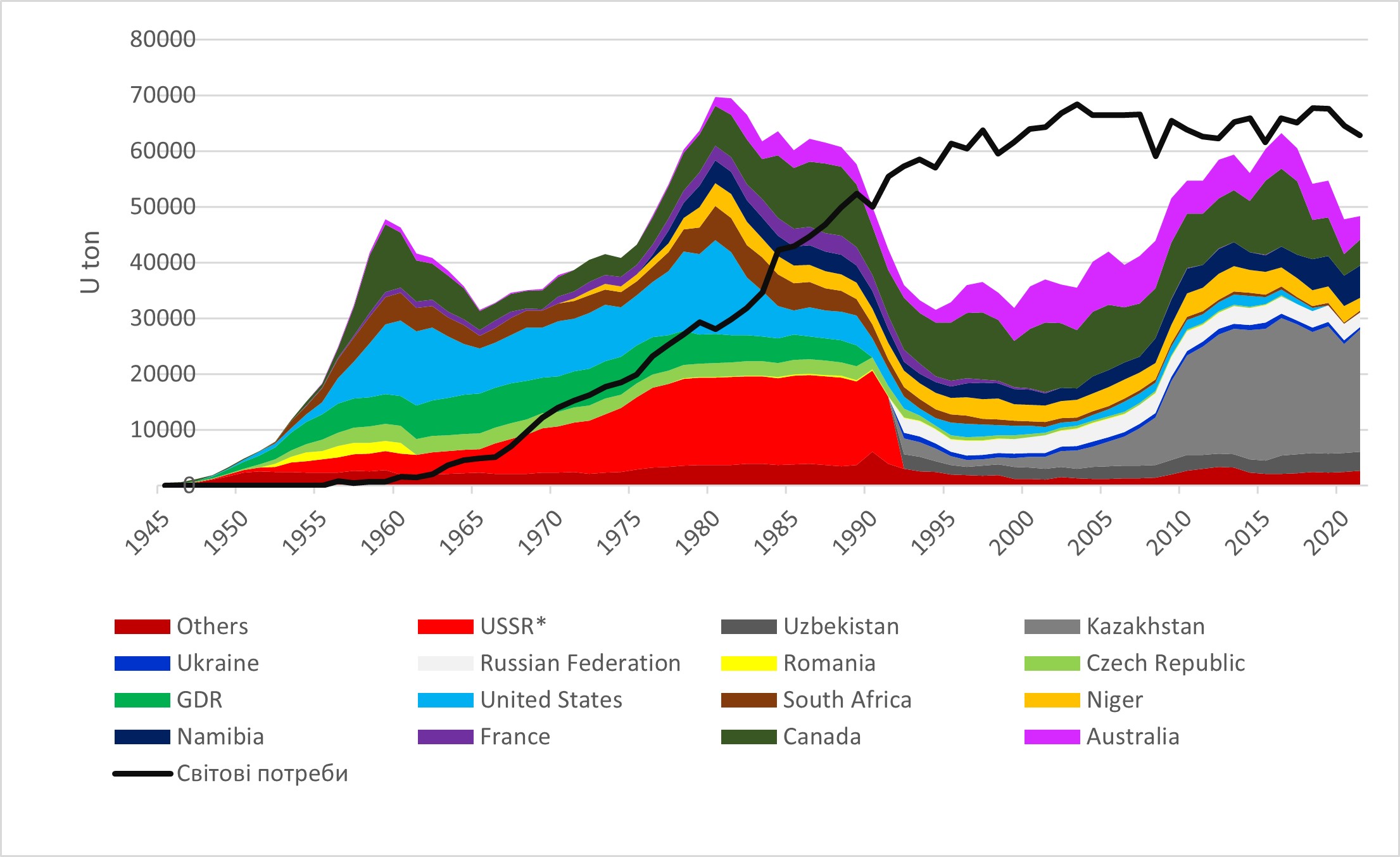
Figure 2. World uranium production and consumption. Source: Red Book.
Uranium mining in Ukraine: prospects.
In 2019, uranium mining in Ukraine was unprofitable, as the cost of production at Novokonstantynivske, Smolinskе and Ingulske mines ranged from $79 to $143 per kg, while the market price at that time was $55.40 to $65.78 per kg. It is not known whether the cost of uranium production at Ukrainian mines has changed today.
Uranium ore mining in Ukraine meets 30% of the needs of the domestic nuclear power industry. Today, Ukraine has no uranium enrichment plant or fuel production facilities for nuclear power plants. Prior to the full-scale invasion, Ukrainian uranium concentrate was shipped to Russia for enrichment and fuel fabrication. The resulting nuclear fuel was then shipped to Ukrainian nuclear power plants.
In 2021, State Enterprise «National Nuclear Energy Generating Company «Energoatom» began work on establishing the production of nuclear fuel (fuel cassettes) using Westinghouse technology at the Eastern Mining and Processing Plant. According to the statements of the Minister of Energy of Ukraine Herman Halushchenko, Ukraine is moving forward with a project to create its own fuel production facility. It is planned to complete licensing in 2023 and start commercial production of nuclear fuel components in 2024. President of Energoatom Petro Kotin added that by 2026-2027, the company plans to create its own nuclear fuel production line.
According to the Red Book, Ukraine has uranium reserves with an extraction cost of about $80/kgU, and with market prices for uranium at $95/kg, uranium ore mining and processing in Ukraine should be profitable.
*It should be noted that in order to understand the economic component, it is necessary to make a technical and economic assessment (ni-43-101, JORC) for each prospective uranium deposit before starting development.
Today, uranium ore mining in Ukraine, given the high market prices for uranium, can be interesting not only as a raw material for domestic needs but also for export. In addition, Ukraine has ambitious plans to increase electricity generation through nuclear power plants. Work is also underway to establish the production of components for nuclear fuel. If in the future Ukraine manages to establish nuclear fuel production together with its partners, then only a uranium enrichment plant will be needed to complete the full nuclear fuel cycle.
Given all of the above, Ukraine has the potential to increase uranium ore production and attract new technologies and investments to Ukraine.
*Main image: uranium concentrate, photo by DANIEL ACKER


We will call you back!
Visit the main office:
Lviv, Uhorska Street, 14
(business center "DOMINANT PLAZA")
Write or call:
geological.investment.group@gmail.com +38(063)310-46-74